Tuesday, November 16, 2010

Accra


17/11/10

I've been in this city for close to a month now so I'm going to try describe it, as best I can.

Accra is a hard working city. With sunrise, Ghanaians are up - making ends meet. The city is covered in roadside stalls, selling products that don't differ much from each other, mostly food stuffs, drinks and souvenirs. It sometimes feels as though Accra itself is simply a large marketplace, although when you are stuck in traffic, that is a world on its own.

Jams last all day long. Taxis, cars and tro-tros going in and out of the city centre vye with eachother for whatever space is available. Drivers here are incredibly focused and skillful and they have to be, or they wouldn't move. Whoever shows the most gusto wins right of way.

A byproduct of Accra's traffic jams are hawkers. A large number of Ghanaians cater to the stopped traffic. From loads usually balanced on their heads, women, young men and children (sometimes very young) sell everything from water, mints and newspapers to dvds, posters and rubix cubes. When I first saw this, I found it entrepreneurial and clever. But after more time, I now find it confronting. Some lines of traffic have dozens upon dozens of people hawking and it is obvious that they don't earn a lot. The conditions they work in are harsh: the heat can be very intense and the traffic creates a lot of pollution.

Wherever you go, Ghanaians are typically friendly to the foreigner. A lot of people introduce themselves to you and in a short amount of time, you get to know the locals. Some want your business and others simply want to know who you are. A lot of life takes place on the streets here and just because someone stops you on the way somewhere, that's no reason not to give them a minute. From my encounters, I've met countless nice people and I've only run into a few that I would call negative and no more than in any other city I've visited.

The infrastructure here is poor. It feels incorrect, given the professional manner in which so many Ghanaians operate. Accra is as an African city with a good economy compared to much of West Africa, but piles of rubbish, long open drains and vast spots of abandoned land are common sights.

Animals, such as goats, chickens, cats and dogs wander freely around the streets. You walk alongside them. The goats and chickens I can only presume have owners who are nearby and as for the cats and dogs, I have no idea.

Every now and then, something will shock you. The other day, I was in a taxi stopped at some lights. I looked out and on the side of the road saw a man sitting under a tree, wearing some amazing boots. They were green, bumpy and looked to be leather. They started at his knees and grew very large at his feet. Like something out of a video game. I gave them a second look and as he went to lift them with his hands, I realised that they were actually his legs.

Wherever you are, people in Accra are working tirelessly to earn a living, out of whatever stake the city can afford them. It is a captivating place to live - exhausting one moment, totally enthralling the next.

Friday, November 5, 2010

Lunch in Togo and the Wli Waterfalls

31/10/10

With Friday negotiated off, I went with eight other PA volunteers to spend a 3-day weekend in a village called Wli (pronounced Vlee). Wli is around a 5 hour tro-tro ride north of Accra and borders Togo. The two countries are divided by mountains. It is home to the largest waterfall in the region and so a popular tourist spot.

The ride up was hot, scary and a small part fun. Tro-tros making the journey between towns go very fast. The roads have numerous pot holes, drivers narrowly dodge each other and pedestrians and the vehicles themselves are ancient, with cracked windscreens, parts missing and very squishy seating. The best thing to do is to put your faith in your driver, sit back and enjoy the view.

Our accommodation in Wli was nice and on Friday afternoon, we visited a lower area of the Waterfall. This was about a two-hour trek through rain forest, along a well-trodden path. It was a pleasant first walk through an African rainforest. It wasn’t too hot, as there was a lot of cover and I didn't see any lions - Thank God. The Waterfall itself was stunning. Thousands of bats hovered around the top and the force from the water created a powerful chill, so it felt very refreshing.

At the entrance to the park, several women run stalls catering for the stream of tourists who venture onto the mountain. They are very competitive with each other and each time we passed through, they worked extremely hard at getting us to shop with them and would make arguments like "You can’t buy from her, you bought from her yesterday". They mostly sold cold drinks and biscuits, and I assume it was their main source of income.

On the way back from this first walk, I bought a small packet of choc-chip biscuits from one of them. There were twelve biscuits inside and it cost 1 Cedi, or about AU$0.70c. As I walked back to our accommodation, I opened it up and some local kids surrounded me, eager for one each. So I gave a young girl a stack of them – counting out 9 – and told her to share them around. As I moved on, I noticed two women standing nearby and they approached me, looking a little stern. I started to apologise, thinking that maybe I wasn't supposed to give the kids junk food. They stared at me for a moment, before asking if they could have one too.

That night, we made our plan for the next day. Our group of nine would leave early in the morning and set out on an all-day hike up the mountain, to see both a higher area of the Wli Waterfalls and cross the border into Togo, where we would visit a small village and have lunch. We arranged to go with the same guide we’d used for our trip to the Lower Waterfall, a man named Anthony. We went to bed quite early, as Saturday would be an early start.


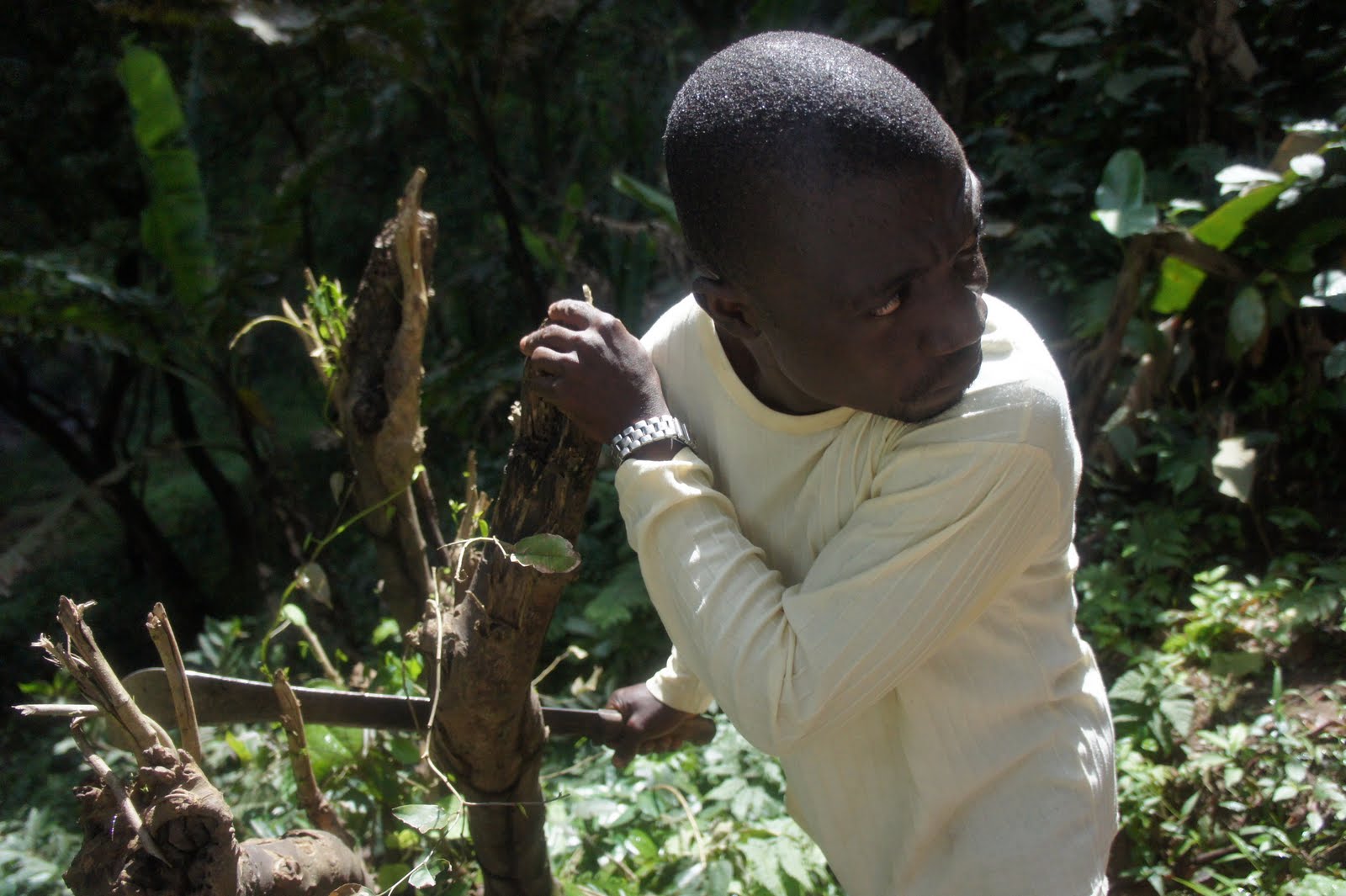
We set off at around 7.30am, taking with us a backpack each, swimming gear (we'd heard you could swim in the waterfall) and bottles of water. The first hour or two was the same trek as the day before: wide, flat and easy. After that, however, the path became very, very steep. Very quickly, it grew tiring. We climbed the mountain single file, with Anthony leading the way. Every now and then, he used his machete to cut away areas of the path that were overgrown. After close to two hours of the exhausting ascent, we reached the upper area of the Waterfall.


It was okay. Waterfalls don’t differ a whole lot in appearance and we didn’t swim in it (it was too powerful and not deep enough to be enjoyable), so it didn’t feel that much different to the one the day before. We rested there for a while, cooling down under the powerful winds created by the water's force, before setting off again, back up the mountain to follow the trek to Togo.

The mountain continued in its steepness and intensity. We continued climbing as before, in single fire and following Anthony’s lead and it took a lot longer than any of us expected. We had many pauses, as Anthony wanted to always ensure that we were all still there but this caused a fair bit of frustration among the group, as it took energy to stand still against the steepness.

A couple of hours later, the ground began to flatten. Around half of the group were Football volunteers with Projects-Abroad, but otherwise we were all fit enough that we coped with the climb. Anthony told us that it would be another 25 minutes to Togo, making lunch feel very close.

The border was a small river with two wooden planks laid out across it. The crossing wasn’t an official one, so there was no need for passports or visas. We crossed, one by one, and kept on walking.

Anthony, at this stage, made a habit of telling us that we were closer than we really were. His brief way of communicating with us meant that he would just answer that it wasn’t far, or say something like “20 minutes”. From the border to the village itself, we walked for what felt like ages, along a few different roads and around 2 o clock, we reached Tsadome.


Tsadome is a village of several hundred Togolese, all of whom come from only four families. In the town, there is a school of six classrooms that teaches around two hundred students, including many from surrounding villages.

As it was a Saturday, none of the children were in school and so they swarmed us on our arrival. They found us really fascinating and took a lot of joy in simply watching us, and especially playing with our cameras. A few were shy and watched us from around corners or from behind others. It felt as though we could’ve been the first foreigners to visit the town in a very long time, but Anthony said that the most recent trip had been around two months ago.

A few of the townspeople started cooking lunch for us when we arrived. We were insistent that it had to be fast as we had to get back down the mountain before nightfall, and despite their offer, it wasn’t practical for us to stay the night.

Very suddenly, as we sat on the porch of a small shop with the children, it started raining. Like the few times it's rained in Africa while I've been here, the downpour was very intense. It started to get very wet and we all went for cover inside the tiny shop. The rain was on and off again and it became very cold, and so there was uncertainty in the group about what we were doing.

While lunch was being prepared and in between the rain, we were given a brief tour of the town. The centre of Tsadome is mostly housing built from clay and dutch roofing and the outskirts is farmland. It is about 10km away from a larger city, which is where a lot of the townspeople travel to sell their produce.

Lunch took a long time to make and we all grew more impatient, as we had worked out already that we couldn’t stay the night and Anthony was continually elusive, so it was difficult to hurry things up. Eventually, at around 3 o clock, they served us lunch. It was one the nicest meals I've had in Africa and the one with the most vegetables.

We ate very fast, paid and found Anthony, insisting that we had to leave right away. He got the drift, but it still took him a while to organise himself. At around 3.30pm, we paid for our lunch and some drinks and left very promptly. We had a couple of hours to make it back down, or we risked facing the mountain in the dark.

Energized by the food and the threat of darkness, we walked very quickly, not stopping once. The mountain was wet in parts and so there was plenty of slipping on the way down. Anthony cut us all long sticks with his machete and insisted we all use them to help with the descent. They helped a lot.

The return trip was much faster than the journey up and we hit the flat trail again by around 6pm, as it got dark. We made it back by around 6.30pm, ending a long, exhausting but rewarding day.

On Sunday, we left Wli and on the way back to Accra stopped by a seaside village to go sailing in the Lake Volta. At first, they couldn't accommodate all nine of us on one boat but after a while of officials running around and negotiation on our part, they found a large boat and took us for a 45 minute ride. For some reason, two navy guys were on board, both armed and it wasn't the most captivating ride.


We returned to shore, had a quick look around the coastal township, the highlight of which was the sight of three men loading a large cow into the back of a taxi. Granted, the car was a station wagon but then, the cow was alive. Tired, we caught a tro-tro back to Accra for the bumpy ride home.

Monday, November 1, 2010

Bob Marley, the weather and my first weekend in Ghana

25-10-10

My first morning in Ghana was stormy. After arriving at the airport late the night before and being hit by the humidity, I was surprised to wake up to intense rains and winds. The night before, my plane in South Africa had been delayed by a thunderstorm, so maybe it was the same one. Areas were flooded and traffic in places couldn’t move. By mid-afternoon, it was hot again. And every day since has been hot too.

The heat here is as you might expect: humid and harsh. Temperatures at this time of year don’t get much higher than 30 to 35 degrees, but the city of Accra requires that you walk to many places, making it all the more extreme.

On the weekend, well and truly ready to hit the coast, I visited nearby coast town called Kokrobrite for a large reggae party. The ride to Kokrobrite was by mini-bus (Tro-tro) and to travel 20km to the town cost 60p or around AU$0.40c. Around twenty people from projects-abroad went along, and Saturday afternoon was spent mostly lounging around on the beach, basking on the sticky sand and swimming in the perfectly cool sea.

The beach resort –Big Milly’s – wasn’t tro-tro cheap but still very affordable. Around 10 o clock, the reggae started and kept going without break for the next four hours. The party was a mixture of fewer tourists and more Ghanaians. Many of them were Rastas, short for Rastafarian, a deeply spiritual group who really, really, really love Bob Marley. One of the more popular songs of the night was a rendition of his name, over and over again. The reggae dancing was wild too and the only rule was to mix it up. If you were getting boring, there were rastas eager to show you some moves.

As it got late and the music stopped, the night moved onto the beach. Some neighbouring bars stayed open and there was a large drum session at one and then a bon fire on the sand. After that, everyone flocked to see something in the distance. A gigantic sea turtle was laying its eggs and a man stood over it with a flashlight in one hand and an open hat in the other.

Sometime later, back at Big Milly’s and sitting around exhausted, but too tired to go to bed, the night felt like it had finished. And then there was a loud bang. None of us had a clue as to what it was and a guard strode out of some nearby darkness, walking slowly, with a rifle in his arm. For some reason, he fired it a second time at what looked to be nothing, before wandering off to watch a movie with a dozen other Ghanaians over by the bar.

We decided to call it a night after this and all went to bed.

Day 2 at the B&FT

22-10-10

Shortly after arriving at work, I was told to go on assignment with a journalist named Leslie. We hopped into a cab outside and I tried to find out from Leslie what the assignment was but he said he didn’t know, only that it was at a Shell petrol station near the main airport. In less than twenty minutes, we were there.

Nothing looked out of the ordinary. Lesley asked a worker what was going on and we were directed to a spokeswoman nearby. She quickly explained that today was Shell Customer Safety Day and that all of Shell’s Ghana staff had been deployed to its petrol stations to inform customers about road safety. As she said this and I caught sight of a dozen Shell employees all wearing bright red t-shirts, I felt my adrenaline drop. I spotted a list on a nearby table with a dozen media organisations listed and their contact details. It was nothing more than a PR event. The spokeswoman pointed at a nearby Shell manager and said that we could speak to him if we wished, and so we accepted.

Leslie, 23, and quite new to journalism himself, asked me to help him come up with some questions to ask Omar V. Benson, Shell’s managing director. We brainstormed for a few minutes and devised a list.

Leslie conducted the interview and our questions all received the same well rehearsed lines that were designed to highlight Shell’s corporate social responsibility. Before long, we hailed a cab to return to the office.

In the taxi, I chatted with Leslie about the event and was surprised to see Leslie totally embrace Shell’s agenda. People don’t really wear seat belts in Ghana and that had been one of the recommendations. Leslie tried to buckle his but not unusually in Ghana, it didn’t work. Leslie suggested the driver try his and the driver merely laughed back, not taking the idea seriously.

Back in the office, Lesley asked me if I would write up the story. I worked with the managing director’s remarks and a press release Shell had provided us with and starting work my first article. I managed somewhere between 250 and 300 words, got it in by the 4pm deadline and the deputy editor was happy with it.

So, on Monday - assuming my article stays put in the box I left it in and the editor himself doesn’t raise any objection to what I’ve written – I’ll have my first piece published. It’s not a groundbreaking news story but nevertheless, I found it interesting to write and am excited by the prospect of appearing in a newspaper! I’m happy with the subject matter too, as road safety is a serious issue in Ghana and one that needs more attention, irrespective of where it comes from.

Tuesday, October 19, 2010

From South Africa

19-10-10

On the plane over here I was grappling with the dilemma of whether or not I should go back to work at my most recent job, at Safeway, when I return to Australia in February. The job pays as well as any at my age and job searching is always a hassle. But then, change is sometimes good for you and it helps to keep life interesting.

I was unable to come to a decision and neither was Greg, a Zambian I met on my second night in South Africa. We got talking at a hostel in Pretoria and he told me about the decision he faced with his job at the moment: a two-year contract he was on with one of Zambia's biggest TV stations had ended and to continue with the job (after close to five years there), he must sign a new 25-year contract.

Greg, 30, was a nice guy, went to Uni in London and had parents who were very well off by Zambian standards. A country where nearly 70% of the population live below the poverty line, making it one of the world's poorest.

The terms of Greg's new contract said that if he quit his job in the next 25 years, his pension would go back to the government. If he dies, he forfeits it as well (Zambia's life expectancy is 37, a point that Greg kept bringing up).

In the few days we spent together at the same hostel, I could never gauge which way his mind would go. At times, he treated it like his only option and he was fully aware of the importance of a stable job in his homeland, even without the freedom to quit without a significant sacrifice, especially if he wanted to start a family any time soon. Other times, he wouldn't stop talking about travel and all the places he might go to try his hand at a new career.

Anyway, I found it to be an interesting bit of perspective - from my first few days in Africa.

Friday, October 1, 2010

My travels

01-10-10

While in Ghana, I'll be doing a 3-month journalism internship through projects-abroad, a for-profit volunteer and internship organisation that enlists thousands of participants every year.

After a 5-day stop over in Johannesburg, I arrive in Ghana to spend two months at the Business and Financial Times in Accra, Ghana. The newspaper is published on Mondays, Wednesdays and Fridays and "provides in-depth coverage of the relevant issues in major sectors of the economy". This coverage ranges from mining to stock markets to aviation. I will be shadowing professional journalists and my overall responsibilities will depend on how well I prove myself while there.

I'm looking forward to this. The problems synonymous with Africa, from disease to poverty to corruption to civil conflict, are inexplicably tied into economic leadership and business is increasingly becoming the focus in many African nations, especially Ghana. The B&FT promotes itself as being the "longest-running and most authoritative business paper in Ghana". I hope that by working there, I'll learn how the business echelon of Ghanaian leadership operates and what it sees for the country's future, as well as the rest of Africa.

Once my business paper stint is up, I spend a month with the sports department of the TV3 Network, also in Accra. Again, I know Soccer to be very big in Ghana and I hope that my time here will provide a more social look at the country's direction. The Black Stars performed well in the World Cup too, so I expect the mood will be an excited one that I will be able to learn a lot from.

After my internships are over, I travel independently around East Africa for 4 weeks. I start out in Nairobi, Kenya and beyond this, I don't know yet, but I would love to see Uganda, Rwanda and Tanzania.

Tuesday, September 28, 2010

Sydney and lost belongings

21-09-10

I lost only one thing in Sydney over three days. As this was my first trip anywhere far away in a long time, I was pleased with this result. Coming home, I thought to myself, how good would it be if I could achieve that while in Africa?! Well, after some calculations, I'm not so happy about it anymore.

Numbers of items I lost: one, my return sky-bus ticket.

Numbers of items I took to Sydney: approximately 30 (Clothes, books, travel documents, toiletries, a pack of cards, wallet, mobile phone, etc - all together it weighed less than 10kg and fit into one backpack).

Number of days I spent in Sydney: three

1/30 is 3.333 items per hundred. In Africa, I'm hoping to travel light but it's a much bigger trip and so I expect that I will carrying close to 60 items.

The math: With a losing rate of 3.33 items per 100 every 72 hours, I'll lose 60
items or all of my belongings by day 100 of my trip. This is the 22nd of January 2010, which just happens to be the day I finish up in Ghana and fly to Kenya to start four weeks of independent travel.

I panicked after coming to this result, as the prospect of traveling around East Africa with nothing except for the clothes on my back(I didn't count them in my calculations - they're very hard to lose) is a frightening one. However, I pride myself on being able to solve any problem, from easy soduku to the hodge conjecture to difficult soduku. So,
I came up with a solution. There are two parts to it.

The first is a losing schedule. Rather than lose items randomly that might be integral to what I want to do on a particular day of my trip, I'll devise a schedule for which item I'll lose when.

I've written up a quick summary of what such a schedule will look like:

October 2009

13th: Fly out from Australia
16th: Leave my toothbrush in a Johannesburg hostel
19: Forget to take a book I'm reading out of the seat pocket in the plane.
21: Leave my mobile phone on a bus.

... and so on.

It might look a little bleak but if I know what I'm going to lose when, I can plan accordingly, minimizing the overall harm to my trip.

The second part of my solution is something I'll term Focusing my losses. As I lose my belongings, I'll buy cheap replacements so that I am not left with a situation where all I have left to lose are my more expensive items, i.e. my Passport.

If I lose my toothbrush, I'll buy a new one that day. Same goes for socks, pens and books. I'll roster these replacements into my losing schedule right away, along with the occasional bigger item, like my mobile phone, and if I'm lucky, my forgetfulness will fall for it.

If I'm successful, when I return home on the 20th of Feb 2010, I'll be carrying the same passport, wallet and laptop that I left Melbourne with.

Wish me luck!

Monday, September 13, 2010

A Space Story

13-09-10

Flying, lions and 4 weeks until I go

13-09-10

For a long time now, my deepest fear has been the one of my plane going down in the jungle and I survive, only to be eaten by a lion. Small chance I know, but in a way that only makes it worse, because if the scenario actually occurs, it will be even more horrifying from the shock of such long odds being realised.

If I try dissect this fear, I'm left with a common fear of flying. From a quick google-diagnosis, I can quite safely say that the media has instilled it in me. I never used to hate flying, but then I never used to expose myself to news like I do nowadays. Plane crashes always get reported on, by all the big outlets. A few months ago, after yet another big crash, it occurred to me that I'd lost count of how many plane crashes I've read about in the last couple of years. I wondered if it really was a lot, or if it just seemed like a lot because of how much attention I gave them. Not a problem, it turned out, as along with its coverage on this crash, CNN churned out an article chronically all the big ones of the decade. I think they missed some.

It's definitely the media's job to report on crashes – they are huge tragedies that capture people's attention - so I don't take issue with that, but I would prefer it if they could at least include a footnote with statistics about the planes that do land, day in, day out, at the bottom of crash pieces. It would be a nice gesture for people like me, on whom the logic of why penguins can't fly but planes can is lost. It would be token-ish, sure, but no different to having a life jacket under your seat.

I don't really know how to overcome my fear and it's big enough that I can't justify watching Doctor Retired Pilot or whoever on YouTube to try to fix it. If my plane was then to go down, my misery would be far worse, as I'd feel like I'd wasted my short life on YouTube. It's a tough spot to be in, but I expect by February next year, after fours months of travel around Africa, encompassing more than ten flights(1), in which time I'll be avoiding Safari fervently (I see enough lions when I go to sleep), I'll be cured.

Welcome to my blog: a home for my many anxieties and failures, between now and the end of my trip. I will post up stories, articles and the odd photograph as well. Thank you for visiting and I do hope that I get to write more!