Here's a list of posts from first to last.
Thursday, April 7, 2011

Friday, March 4, 2011
Home sweet home
In typical blog fashion, it's been a while since I've made a decent update. The main reason for this is that I'm now home, my Melbourne life as busy as ever, and my travels are all but finished. In my last fortnight, I went to Rwanda, Uganda and then Kenya. All were very different to each other and I stayed in some amazing cities, met some great people and continued to see ways of life that are totally different to mine.
As things stand, Uni has commandeered my life back in Melbourne and so I'm going to refrain from going into my last leg at this point in time. Rather, I think I will write lengthily about Africa in the near future - away from my blog. The piece I want to write will deal with what it was like to swap my Melbourne life for my Ghana life. Additionally, I plan to explore the pros and cons of volunteering overseas, asking questions like "Is it really worth it?" and "What is the best way to go about it?" and more centrally, "In opening your mind and life up to a less fortunate part of the world such as Africa, is opting for a volunteering stint an easy way out, morally speaking?"
No idea when I will write it - only that I will - and so until next time, thank you for visiting!
Sunday, February 6, 2011
Living it up in East Africa
Just after dark last night, I arrived in Kigali, Rwanda. The bus trip from Mwanza (my last stop) was 13 hours and so I arrived a little tired. My last 4-5 days have been in Tanzania, but it is such a big country that I really only feel like I passed through it. I hope to see it properly one day.
Arusha and Mwanza, the two Tanzanian cities I stayed in, didn't offer me much to do. Arusha provides a great view of Kilimanjaro and it sounds a little dumb to say, I was surprised at how big the mountain actually is. But the city itself is very much geared towards the tourist actually visiting Kilimanjaro, leaving me a little bored. The bus ride from Mombasa to Arusha was my least enjoyable yet too. It terminated halfway along the route, dodgily and without any warning, and this was after I had patiently slept in the thing overnight, while it parked in a marketplace. In total the trip, which was cold, bumpy and painfully cramped for hours at a time, took 18 hours, but on a good day, could've easily been finished in 7-8.
Mwanza, a town on Lake Victoria, between Arusha and the Rwandan border, was a conventional stopover destination. I found a comfortable hotel and spent a few days there - catching up on sleep after the aforementioned bus ride and writing, reading, walking around, that sort of thing.
I will be in Rwanda until Saturday, at which point I head north to Uganda. The countryside here is some of the most beautiful I have ever seen. It is made up of endless hills, of varying shapes and sizes, a thousand different types of green and very alive with life.
The Tanzanian countryside was similarly impressive, especially in the north-west. From the bus window, the land was as vast as I have ever seen it so that in parts you could even see the shadows of whole clouds on the ground. Trees of endless variety, rocks from tiny to huge and vast fields characterize the countryside and like Rwanda, it is all very alive with life. Stunning for its scope too, as I watched it for hours on end and yet it the view at any point would continue for hundreds of kilometers .
On the photo front, I have very few. oops. I regularly find myself in situations where it would be obviously inappropriate or rude to pull out my camera and one thing I have learned while in Africa is that so often, the moments that would make the best shots are also the ones that are the least okay to take a photo of. I have witnessed foreigners disregard this, and seen moments or encounters totally spoiled, with some turning quite ugly.
Nevertheless, I am into the final two weeks of my trip and I don't have that much faith in my memory or ability to describe and so I will endeavor to take some more shots - even if they do just end up being of coffee cups..
Arusha and Mwanza, the two Tanzanian cities I stayed in, didn't offer me much to do. Arusha provides a great view of Kilimanjaro and it sounds a little dumb to say, I was surprised at how big the mountain actually is. But the city itself is very much geared towards the tourist actually visiting Kilimanjaro, leaving me a little bored. The bus ride from Mombasa to Arusha was my least enjoyable yet too. It terminated halfway along the route, dodgily and without any warning, and this was after I had patiently slept in the thing overnight, while it parked in a marketplace. In total the trip, which was cold, bumpy and painfully cramped for hours at a time, took 18 hours, but on a good day, could've easily been finished in 7-8.
Mwanza, a town on Lake Victoria, between Arusha and the Rwandan border, was a conventional stopover destination. I found a comfortable hotel and spent a few days there - catching up on sleep after the aforementioned bus ride and writing, reading, walking around, that sort of thing.
I will be in Rwanda until Saturday, at which point I head north to Uganda. The countryside here is some of the most beautiful I have ever seen. It is made up of endless hills, of varying shapes and sizes, a thousand different types of green and very alive with life.
The Tanzanian countryside was similarly impressive, especially in the north-west. From the bus window, the land was as vast as I have ever seen it so that in parts you could even see the shadows of whole clouds on the ground. Trees of endless variety, rocks from tiny to huge and vast fields characterize the countryside and like Rwanda, it is all very alive with life. Stunning for its scope too, as I watched it for hours on end and yet it the view at any point would continue for hundreds of kilometers .
On the photo front, I have very few. oops. I regularly find myself in situations where it would be obviously inappropriate or rude to pull out my camera and one thing I have learned while in Africa is that so often, the moments that would make the best shots are also the ones that are the least okay to take a photo of. I have witnessed foreigners disregard this, and seen moments or encounters totally spoiled, with some turning quite ugly.
Nevertheless, I am into the final two weeks of my trip and I don't have that much faith in my memory or ability to describe and so I will endeavor to take some more shots - even if they do just end up being of coffee cups..
Monday, January 31, 2011
East Africa update
I'll work in dot points today.
Cities
1. Mombasa. In total I spent around 3 days here, as the city is central to Kenya's coastal region. This city, Kenya's second-largest, is very different to Nairobi. It feels more African: the roads are hectic, traders fill the streets and it is heavily populated. It is a noisy place and tourism isn't a big deal here - this is reflected in the cheap prices available and attitude of locals: the only people who vied for my business were drivers. On the whole, people simply showed me indifference.
2. Lamu. 7 1/2 hrs north of Mombasa, along the coast, plus a short ferry ride. It's a paradise compared to Mombasa, with architecture so attractive that it almost feels fake. The city's main streets are narrow passageways between old tall Swahili buildings and donkeys roam free. The people are almost entirely Muslim: women living on the island almost all dress in burqas and mosques wake you up very early in the morning. The island is heavily dependent on tourism and I was made to feel very welcome there.
3. Diani Beach. I stayed in a district called Ukanda Junction, just near Diani Becah, one of Kenya's most popular beaches. The junction serves as a marketplace for locals and the main matatu (minibus) station for the area of Ukanda and it is very noisy. A short matatu ride to the shore itself takes you to Diani Beach and it is like entering another world. There is a large mall, resorts, bars, restaurants and the area has fine infastructure. The main supermarket there even has a deli. And if the first mall isn't enough, there's a second smaller one nearby. All together it makes for a naturally stunning spot in Kenya (and the beach really is beautiful) that doesn't feel one bit Kenyan. Very popular among tourists.
Cities
1. Mombasa. In total I spent around 3 days here, as the city is central to Kenya's coastal region. This city, Kenya's second-largest, is very different to Nairobi. It feels more African: the roads are hectic, traders fill the streets and it is heavily populated. It is a noisy place and tourism isn't a big deal here - this is reflected in the cheap prices available and attitude of locals: the only people who vied for my business were drivers. On the whole, people simply showed me indifference.
2. Lamu. 7 1/2 hrs north of Mombasa, along the coast, plus a short ferry ride. It's a paradise compared to Mombasa, with architecture so attractive that it almost feels fake. The city's main streets are narrow passageways between old tall Swahili buildings and donkeys roam free. The people are almost entirely Muslim: women living on the island almost all dress in burqas and mosques wake you up very early in the morning. The island is heavily dependent on tourism and I was made to feel very welcome there.
3. Diani Beach. I stayed in a district called Ukanda Junction, just near Diani Becah, one of Kenya's most popular beaches. The junction serves as a marketplace for locals and the main matatu (minibus) station for the area of Ukanda and it is very noisy. A short matatu ride to the shore itself takes you to Diani Beach and it is like entering another world. There is a large mall, resorts, bars, restaurants and the area has fine infastructure. The main supermarket there even has a deli. And if the first mall isn't enough, there's a second smaller one nearby. All together it makes for a naturally stunning spot in Kenya (and the beach really is beautiful) that doesn't feel one bit Kenyan. Very popular among tourists.
Tuesday, January 25, 2011
Leaving Ghana, Kenya and empty promises
On Saturday, I flew out of Ghana. My three months are up and now it’s onto East Africa. My final two weeks were in both Cape Coast and Accra and the bulk of my time went into tying up my Ghana life, while preparing for my next month in East Africa.
I’ll start off with an update on Coastal TV. After the fire, the station moved its operations to its smaller studio in the city. The images I posted in my previous entry are of the fire damaged main studio, which is where the bulk of the station’s day to day operations took place. Since the blaze, the station's two flagship programs Sound Check and KASA have moved to being recorded outdoors and the station has launched an appeal, which is advertised in a bar running across the bottom of the screen. The damage bill is estimated at being over $100,000, but not many people in Ghana have money to spare, especially those in the Central Region and so charity is unlikely to make up for much of this. The station did not have insurance and so the end result will most likely be that Coastal TV keeps on running, only on fewer resources.
Visiting the fire’s aftermath was a strange experience, as it had been my workplace for a month prior. Stepping over the ash and rubble, it felt as though the blaze must have been huge, but over quickly and now firmly in the past. The main studio was attached to a household, but the fire brigade were able to stop the blaze from spreading and so only the Coastal TV studio was destroyed. The experience was sobering and the attention my co-workers have since given to continuing the station’s broadcast and looking towards the future has been nothing short of inspiring. Very little time has been allowed for self-pity.
Mid-last week, I moved back to Accra for my last three days in Ghana. Before leaving, I said goodbye to my last host family, although my host aunty wasn’t there. It turned out she had left for Accra a day or two and didn't bother letting me know. I didn’t mind, as the whole time I was there, she ranged from being overly businesslike to outright rude and I wouldn't say we connected. The rest of the family were lovely however and the kids a lot of fun and I will miss them a lot.
In Accra, I stayed at a Salvation Army hostel and relished in doing a lot of small things for the last time. Walking along Accra’s Oxford St and shrugging off a more aggressive breed of rastas. Visiting West End, our local drinking spot – a football pitch covered in plastic chairs. Sharpnet, Circle, riding tro-tros and of course, the mall. I spent a lot of time devouring Ghana’s street ice cream too. Until I was actually on the plane and looking down at Ghana, there was always seemed to be one more FanIce that would be my last.*
On my last night, I went to an Italian restaurant called Mamma Mia’s with a big group of my Accra friends and Cape Coast ones as well, who were in the big city for the weekend. It was a great evening and really I couldn't have asked for a better send off. In anticipation for my next month of cheap and at times remote backpacking, I ordered a four cheeses pizza and some (relatively) expensive red wine.
Cut to Nairobi.
On the drive from the airport to my hotel at around 2am on Sunday morning, we almost hit a group of giraffes crossing the highway. My taxi driver was mid-sentence through trying to sell me a safari tour when he swerved out of the way. I thought it was amazing and as we kept on driving, my driver kept trying to sell me Safari. It made for unfortunate timing on his part, as that moment more than satisfied all of my Safari desires.
Nairobi meanwhile was very deserted. At 2am in Ghana, the streets are still populated by people, many of whom sleep by their stalls. Nairobi is a large city and quite westernised, with tall skyscrapers, paved roads, big scale advertising and carefully crafted gardens. But at 2am, it is lifeless, in a way that lives up to its reputation . Shops are all closed - seriously locked and gated - and the only people who are clearly visible are taxi drivers, who congregate on the city's corner blocks.
During the day however, the city comes alive. Compared to Ghana, the streets are wide and people always seem to be in a hurry. For the first time in 3 months, I felt comparatively slow in my pace. The main forms of transport are large and somewhat old public buses, cheap-ish taxis and foot.
For my first couple of days in this city, most of my time has been spent at a hostel called Milimani Backpackers. From here, I have been battling to catch up on some sleep (in a noisy dorm of eight) and busily sorting out my Uni enrolment from overseas. Tonight, I leave for Kenya’s coast (with Mombasa my first stop and then a few smaller cities) and after that, it’s onto Tanzania, Rwanda and Uganda.
Finally, I plan to write a more thorough recollection of my time in Ghana soon. And I will endeavour to post more regularly too in the coming weeks, but probably smaller updates, as my time in more places, but for less time.
* My very, very last FanIce was on Saturday morning at 8.30am. I walked down to the local store and bought one straight from the freezer so to stop the risk of it being refrozen or melted, walked back to my hostel and slurped it down in an instant, as I looked out on the sunrise. I left for the airport half an hour later.
I’ll start off with an update on Coastal TV. After the fire, the station moved its operations to its smaller studio in the city. The images I posted in my previous entry are of the fire damaged main studio, which is where the bulk of the station’s day to day operations took place. Since the blaze, the station's two flagship programs Sound Check and KASA have moved to being recorded outdoors and the station has launched an appeal, which is advertised in a bar running across the bottom of the screen. The damage bill is estimated at being over $100,000, but not many people in Ghana have money to spare, especially those in the Central Region and so charity is unlikely to make up for much of this. The station did not have insurance and so the end result will most likely be that Coastal TV keeps on running, only on fewer resources.
Visiting the fire’s aftermath was a strange experience, as it had been my workplace for a month prior. Stepping over the ash and rubble, it felt as though the blaze must have been huge, but over quickly and now firmly in the past. The main studio was attached to a household, but the fire brigade were able to stop the blaze from spreading and so only the Coastal TV studio was destroyed. The experience was sobering and the attention my co-workers have since given to continuing the station’s broadcast and looking towards the future has been nothing short of inspiring. Very little time has been allowed for self-pity.
Mid-last week, I moved back to Accra for my last three days in Ghana. Before leaving, I said goodbye to my last host family, although my host aunty wasn’t there. It turned out she had left for Accra a day or two and didn't bother letting me know. I didn’t mind, as the whole time I was there, she ranged from being overly businesslike to outright rude and I wouldn't say we connected. The rest of the family were lovely however and the kids a lot of fun and I will miss them a lot.
In Accra, I stayed at a Salvation Army hostel and relished in doing a lot of small things for the last time. Walking along Accra’s Oxford St and shrugging off a more aggressive breed of rastas. Visiting West End, our local drinking spot – a football pitch covered in plastic chairs. Sharpnet, Circle, riding tro-tros and of course, the mall. I spent a lot of time devouring Ghana’s street ice cream too. Until I was actually on the plane and looking down at Ghana, there was always seemed to be one more FanIce that would be my last.*
On my last night, I went to an Italian restaurant called Mamma Mia’s with a big group of my Accra friends and Cape Coast ones as well, who were in the big city for the weekend. It was a great evening and really I couldn't have asked for a better send off. In anticipation for my next month of cheap and at times remote backpacking, I ordered a four cheeses pizza and some (relatively) expensive red wine.
Cut to Nairobi.
On the drive from the airport to my hotel at around 2am on Sunday morning, we almost hit a group of giraffes crossing the highway. My taxi driver was mid-sentence through trying to sell me a safari tour when he swerved out of the way. I thought it was amazing and as we kept on driving, my driver kept trying to sell me Safari. It made for unfortunate timing on his part, as that moment more than satisfied all of my Safari desires.
Nairobi meanwhile was very deserted. At 2am in Ghana, the streets are still populated by people, many of whom sleep by their stalls. Nairobi is a large city and quite westernised, with tall skyscrapers, paved roads, big scale advertising and carefully crafted gardens. But at 2am, it is lifeless, in a way that lives up to its reputation . Shops are all closed - seriously locked and gated - and the only people who are clearly visible are taxi drivers, who congregate on the city's corner blocks.
During the day however, the city comes alive. Compared to Ghana, the streets are wide and people always seem to be in a hurry. For the first time in 3 months, I felt comparatively slow in my pace. The main forms of transport are large and somewhat old public buses, cheap-ish taxis and foot.
For my first couple of days in this city, most of my time has been spent at a hostel called Milimani Backpackers. From here, I have been battling to catch up on some sleep (in a noisy dorm of eight) and busily sorting out my Uni enrolment from overseas. Tonight, I leave for Kenya’s coast (with Mombasa my first stop and then a few smaller cities) and after that, it’s onto Tanzania, Rwanda and Uganda.
Finally, I plan to write a more thorough recollection of my time in Ghana soon. And I will endeavour to post more regularly too in the coming weeks, but probably smaller updates, as my time in more places, but for less time.
* My very, very last FanIce was on Saturday morning at 8.30am. I walked down to the local store and bought one straight from the freezer so to stop the risk of it being refrozen or melted, walked back to my hostel and slurped it down in an instant, as I looked out on the sunrise. I left for the airport half an hour later.
Tuesday, January 11, 2011


Monday, January 10, 2011
NYE, Coastal TV and life
Every time I start writing one of these, I end up distracted, a whole lot of new stuff happens and I’m back to being about to about to write one of these. So, with chocolate, twisties and some broken up candy canes by my side, I am going to sit typing, writing and let nothing distract me until it is done. Here goes.
Between Christmas and New Year, my placement at Coastal TV slowed down a lot – as did my life in Cape Coast. The transmitter at the main studio was still broken and the season’s festivities meant that for much of the week, no one was at the office. I spent a lot of time reading, the highlight of which was The Code of the Woosters by P.G Wodehouse, a supposed literature classic, but one that I’d never heard of before. I found the book on the shelf of my previous house in Accra and borrowed it on the basis of the cover, which I love. Also on the basis of the cover, I’ve decided to keep it – so if anyone would like to read it when I return home, just ask.

On New Year's Eve, things picked up a bit. I spent the night at a popular beach resort called Oasis and many of my friends were there. Live reggae played all evening and at midnight, everyone moved onto the beach for a close range fireworks show. Within fifteen minutes of either end of 12 o’ clock – this is Ghana, remember – the show went off and hundreds of people watched and celebrated, locals and revelers alike.
With the start of the year – last week – the transmitter problem at Coastal TV was suddenly solved. After moving the bulk of the station’s equipment from the main studio to a tiny studio in the city, somebody made the executive decision to move it all back, and use the city transmitter at the main studio. With this manoeuvre, the station came back to life.
My internship so far was alongside a German volunteer named Uta. Most of our time had been going into trying to master Adobe Premier and editing some footage into something we might get broadcast. I put many hours into studying tutorials online and through a lot of trial and error, we were able to make some progress.
With the main studio up and running again, live recordings recommenced. The station’s two flagship shows are KASA, a political chat show and Sound Check, a music program, both in the afternoon. In the last week I have sat in on lots of these recordings, which are always interesting, especially since the two shows are so very different to each other.
KASA is long (usually an hour and a half) and the panellists mostly speak in the local language, Fante. The first time I watched the program, Coastal TV broadcast The Land Before Dinosaurs on either side of it and the transition between programs was brutal: mid-scene and mid-dialogue.
When I mention KASA to the kids in my household, they express a good amount of disgust and one can see why. Sound Check, meanwhile, is a different story. The show is a collection of popular music videos in Ghana and the 1/2 hour program is hosted by a smooth talking hip young guy. The music videos are always popular and when the show manages to get sponsorship, it is very heavy on advertising. I find the selection of music videos a little difficult to enjoy, but the host is fun to watch. On air, his personality is kind of half-western, half-Ghanaian hybrid and he never stops for a breath of air.
Coastal TV threw up some surprises last week too. Around Christmas time, some weeks back, a Ghanaian woman I work with approached me to see if I would do a voice-over for an ad for a pizza restaurant opening up in Cape Coast. The station is ever fighting to fill its advertising slots and she thought a foreigner’s English would go down well. Since I’m not one to turn down what could potentially be my big break, I happily agreed. I rehearsed that night and came in ready the next day. Unsurprisingly, it was delayed and then continuously so. In this interim period, my co-worker came back to me and upped the ante, saying she wanted me to appear in the video too. A pizza ad! She even laid out the premise: We would stand there and eat some pizza, explaining how good it tasted. I told how much I loved the idea and she said she would get back to me on it.
Last Wednesday, she found me and said we could finally do the voice-over (halfway there, oh well). I entered a small room and sat down at a huge microphone. On cue, I repeated the 30-second script three times over. Afterwards, my request for feedback was rejected with a shrug of the shoulders and they sent me on my way.
And then on Thursday, I attended my first Ghanaian funeral. One of my co-workers lost his mother and in Ghana, funerals are big affairs and if you have even a tiny connection to the person, you are expected to attend. This was a Muslim funeral and all the staff at Coastal TV attended. We started with a visit to the woman’s grave, which was located in the middle of small forest and simply a big mound of dirt. Next, we visited the woman’s local area and met two groups of elders. Each time, the host of Sound Check spoke on behalf of Coastal TV, but his TV voice was gone and replaced by a newfound elegance. On behalf of the station, he offered the son (our co-worker) 100 Ghana Cedis and pointed to three boxes of juice that we had brought with us to the funeral. The funeral was incredibly civil and the mood wasn’t one of upset, but of purpose and deliberation. Most of it took place in Fante, meaning aspects were probably lost on me.
Friday was Uta’s last day and this spelled the end of my video editing career at Coastal TV. The laptop and video camera we’d been working on belonged to her and so we had to finish our work up then. All day, we rushed to finish a short documentary on an Orphanage Christmas dinner but at 3pm – when I had to leave for a weekend away, quite guiltily I should say – I left Uta with the task of putting together the final pieces of our project. We were in need of some assistance from somebody, a daunting challenge, and in the end, she waited for a long time and found somebody and now the piece is completed. Whether the station broadcasts it depends on its need at any given time. We’ll see.
Busia, the Stilt Village and some breaking news
I’ve touched on Busia before so I won’t go too much into it. A group of about five of us, all Cape Coast volunteers, arrived there at around 6pm on Friday and we stayed in a guesthouse that also doubles up as a library.
On Saturday, together with an Australian named Toby and an Austrian named Mario, I set out for Abokwa island. I sacrificed coolness for cheapness, hiring a boogie board, while the other two went with surfboards. The trip went very slowly. For over an hour, I kicked and paddled and the faraway island didn’t really get any bigger. Toby and Mario were very patient with me and for much of the time simply lay flat on their sea-aerodynamic surfboards, every now and then calling out to see that I was okay. After what felt like an eternity, my wild kicking and waving paid off and we reached the island.

Well, we got close enough. The rumour of sea urchins at Abokwa was true and a hundred times worse than I’d imagined. They are black spiky beasts that stick to rocks and the ocean floor. Only a few weeks before, another volunteer had to be rushed to hospital after stepping on one. The shore on this side of the island was covered in them and we decided that it would be best to turn back. Toby and Mario each found a safe looking rock to touch a foot to (allowing them to say that they “technically” reached the island) but I refused even this, on the basis that sea urchins are truly horrible creatures and I wouldn’t even want to give one the satisfaction that it stood a chance at me, they are that ugly.
The trip back was easier. Toby and Mario devised a trick whereby they connected my boogie board to the back of their surf boards, pulling me along. After a while, we developed a rotation system, which was fairer for everybody. In no time, we were back relaxing at Busia.
That night, we visited a night spot called the African Rainbow and saw a show by a singer from New Orleans. He voice was amazing and his stories and random talk between songs even more so. As close as I’ll ever get to seeing Tom Waits live. Here is a clip – only a snippet, but uploading video isn’t a cheap pastime, not over here:
On Sunday, we moved on to another beach spot called Meimei. It was on the way to the Nzuzelo Stilt Village. I’ll sum this spot up in five few words (as I’m running of steam, as you are, no doubt): exclusive, pristine, calm, inconvenient, expensive.
That night, we stayed in a town called Axim, on the road between Busia and Beyin. It is the site of a big fort and a few guesthouses, but otherwise, there isn’t really much going for it (not for the tourist, anyway). We walked for a long while to get to the one restaurant that we had recommended to us, but the bar man said that they had just had a big party and – “Alright, so, here’s the thing” – they were out of food. We ate some kebabs on the street and egg in bread (a staple here) and retreated back to our accommodation, where we watched “Who Wants to be Rich” until we all fell asleep.
The next day – Today – we woke up bright and early to visit Nzuzelo, the famous village on the stilts. We found our way to Beyin and from there, organised the trip through the relevant authority. The only way to get to the village itself is by dug-out canoe along the Amanzule River. This boat ride was a lot of fun. Our two guides, Frederick and Tommy, paddled and steered us for the one hour trip to the village, singing along the way, which started the journey out on a very wholesome note.

On arriving at the village, we were met by a different mood. The place was visibly quite poor and the majority of villagers we passed were either bored or frustrated at the sight of foreigners. The tourism surrounding Nzuzelo is very organised – or official – and the proceeds are said to go into promoting local sustainability. At request, we made a donation to the school – and this required us to enter our details into a records book. The book told of a handful of visitors daily, each providing on average between $2 and $10 for the school. My guess is that for the 450 people who live in the village, the good that this does is rather minute by the times it trickles down to the individual and the feeling of foreigners treading upon what is, by necessity, a very close-knit and intimate way of life, makes for a rather sour trade off.
After an afternoon on tro-tros, we made it back to Cape Coast. Unshaven (in writing, I can use that phrase to total effect, even if it in real life it carries virtually no weight), tired and in need of a shower, I walked in the door and my new roommate Charlie had for me some developments.
Firstly, my mail had arrived.
Secondly, my workplace burned down yesterday.
The main studio in Cape Coast, the sight of my placement, caught fire and nobody could stop it before the place was destroyed. Nobody was injured and the cause has been attributed to an electrical fault.
Some articles on the event:
http://www.ghanaweb.com/GhanaHomePage/NewsArchive/artikel.php?ID=200958
http://news.peacefmonline.com/news/201101/124072.php
Thirdly, Charlie saw my pizza ad on Saturday morning while watching TV. His feedback: “very weird!”
Sunday, December 26, 2010
Coastal TV
Last Tuesday, I started my second journalism placement with Coastal TV in Cape Coast. At very late notice, Projects-Abroad assigned me here, after my placement at TV3 in Accra was cancelled, following a run of disorganisation on their part. But Cape Coast is a great city and while Coastal TV is a much smaller enterprise than TV3, the possibility of experiencing a more close up and hands on internship appealed to me a lot and so I went with it.
Coastal TV's central mission is to promote development in Ghana's central region and give people a stronger sense of pride and identity. The station is supported by a German Charity organisation called DED and it is open to amateurs, semi-professionals and professionals and depends heavily upon the work of volunteers.

The 1st day of my internship proved this last point very well. From the get go, what you contribute to the station depends wholly on your current ability, or on your ability to teach yourself very quickly how to film, report, script and edit. Learning at Coastal TV doesn't really have a lot to do with demonstration and instruction. Rather, you find yourself in the middle of it all, surrounded by a wide range of people each doing their thing, and under a management that has a very open-minded approach to content.
This freedom certainly has an appeal about it but the main drawback of this, not uncommon to this country, is things can move very slowly at times. In my first week, I worked alongside another volunteer named Uta from Germany and we've already had a few hits and misses. Using her video camera, we conducted an interview and did some filming for a story about a dance theatre group and it made for an exciting start. But then it took around three days for another employee at Coastal TV to give us Adobe Premier (video editing software). And we're still waiting for him to convert some footage for us so that we can actually edit it. In the meantime, the station's main transmitter is broken and many of the staff are busily moving a lot of equipment to second but smaller studio located in the city centre.
Nevertheless, as is the case in this country, things do eventually get done. And so, in the next week, we hope to start editing our footage and turn it into a completed piece. If all is successful, we will keep filming and see where it takes us. My feeling is that whatever we can come up with in the next few weeks, Coastal TV will put on air. The first thing I saw when I switched on the station at home was a 5-minute cartoon of Santa break dancing - and this was at 6pm.
On that note, yesterday was Christmas. Ghana is very Christian country - intensely so - and so the 25th of December began with a lot of people heading to church, some very well dressed. Aside from this, the day felt like any other in Ghana, and businesses stayed open. In the evening, there were some festivities and lots of fireworks. Small ones compared to what I'm used to at home but they went on all night long.
Coastal TV's central mission is to promote development in Ghana's central region and give people a stronger sense of pride and identity. The station is supported by a German Charity organisation called DED and it is open to amateurs, semi-professionals and professionals and depends heavily upon the work of volunteers.

The 1st day of my internship proved this last point very well. From the get go, what you contribute to the station depends wholly on your current ability, or on your ability to teach yourself very quickly how to film, report, script and edit. Learning at Coastal TV doesn't really have a lot to do with demonstration and instruction. Rather, you find yourself in the middle of it all, surrounded by a wide range of people each doing their thing, and under a management that has a very open-minded approach to content.
This freedom certainly has an appeal about it but the main drawback of this, not uncommon to this country, is things can move very slowly at times. In my first week, I worked alongside another volunteer named Uta from Germany and we've already had a few hits and misses. Using her video camera, we conducted an interview and did some filming for a story about a dance theatre group and it made for an exciting start. But then it took around three days for another employee at Coastal TV to give us Adobe Premier (video editing software). And we're still waiting for him to convert some footage for us so that we can actually edit it. In the meantime, the station's main transmitter is broken and many of the staff are busily moving a lot of equipment to second but smaller studio located in the city centre.
Nevertheless, as is the case in this country, things do eventually get done. And so, in the next week, we hope to start editing our footage and turn it into a completed piece. If all is successful, we will keep filming and see where it takes us. My feeling is that whatever we can come up with in the next few weeks, Coastal TV will put on air. The first thing I saw when I switched on the station at home was a 5-minute cartoon of Santa break dancing - and this was at 6pm.
On that note, yesterday was Christmas. Ghana is very Christian country - intensely so - and so the 25th of December began with a lot of people heading to church, some very well dressed. Aside from this, the day felt like any other in Ghana, and businesses stayed open. In the evening, there were some festivities and lots of fireworks. Small ones compared to what I'm used to at home but they went on all night long.
Thursday, December 23, 2010
A summary of my time at the B&FT

The Business and Financial Times (B&FT) is a serious business publication based in Ghana. I undertook an internship there for six weeks, starting on the 20th of October, 2010. In this time, the main things I learnt were how a newsroom operates, what the life of a journalist is actually like and how the media functions in a foreign country. I met some amazing people, many of whom were simply brilliant at their work and in the process, made some friends who I hope to have for life.
To begin with, I shadowed different journalists as they went on assignments. For the most part, this involved attending press conferences, ceremonies, corporate functions and other types of officialdom. The experience provided me with an insight into what the role of a journalist really is and on top of that, it gave me a close up look at Ghana’s media system – which is totally different to home.
There was one feature of Ghanaian media that I found to be very interesting. At many events – upon attendance – journalists are given a very generous travel allowance. An envelope with money in it is handed over to help cover expenses. Occasionally, the amount justly covers the cost of a cab but it doesn’t always add up. The events where I saw this taking place were the ones where a large media contingent turned up, usually following a formal invitation. The amounts are typically between twenty and thirty cedis, but the highest I have heard of is fifty cedis. A typical cab ride in Accra costs between five and ten cedis, but almost never more than this.
Journalists in Accra aren’t paid a lot and so these payments no doubt supplement their income. But it is difficult to say whether they impact heavily on what is being reported. Everyone I’ve asked about it says the same thing: the practice is common across the industry. It fits in somewhere between bribery and matter of course. My guess is that if a particular company or organisation failed to provide the allowance, they might not get the same sized media contingent in the future. Similarly, a reputation for providing a more generous amount might draw a larger contingent in the future.
Newspapers in Ghana, to their credit, actually give a lot of space to political news. Politics is a popular topic in Ghana – an African nation regularly hailed as an example of a working democracy – and the media, on the whole, reflects this. A large setback is that two of the biggest dailies are state-owned and so not known to criticize the government, and sometimes blatantly promote it. But private newspapers, of which there are many, are free to do so.
Furthermore, when I pick up a Ghanaian paper, I am surprised by how few stories of scandal and gossip there are, compared to what is common elsewhere in the world. This is impressive but countering this are the system’s many other limitations.
For starters, the reach of print around Ghana is severely limited. GDP per capita across the country is around $1500 or close to 6 cedis a day. A newspaper typically costs 1 cedi. The main audience for newspapers then is the white-collar working class, who are increasing in number in Ghana, but are concentrated in the country’s main cities. For the bulk of Ghanaians, newspapers are simply not a viable purchase. When you are struggling to afford life’s basic necessities, such as food, water and school fees, a healthy intake of news is not very high on your list of priorities. And in turn, quality print journalism suffers from the weak demand.
Compared to the west, there seems to be less of an art to journalism in Ghana. Everything is put together more quickly and on fewer resources. Regularly, stories in papers don’t adhere to journalism fundamentals. Facts will be out of order, with unimportant ones given higher priority over more important ones and obvious questions left unanswered. Leads and quotes are sometimes lengthy and become cumbersome, hampering story flow. And areas like photography, layout and printing quality are nowhere near at the same standard as in the western media. This is attributable to less technology, as well as less expertise. All together, these limitations combine to make reading a newspaper a more cumbersome and laborious task than back home - and this, in addition to limited readership, restricts the print media's effectiveness.
TV and radio are both very popular in Ghana, and while they are primarily a source of entertainment for many Ghanaians, they also act as a main source of news. But like at home, on these mediums, it is rare to find a deeper analysis of current affairs and so they don't fully substitute for print's shortcomings. Something that is also worth it to point out: Newspapers are sold at news stands across all of Ghana's major cities– and it is common to see people standing all around one, examining the day’s news, but not buying it. By doing this, they are circumnavigating the income problem but it hardly solves print's larger problems.
The B&FT has quite a unique place in all of this. The paper promotes itself as being Ghana’s most authoritative business publication and is published on Mondays, Wednesdays and Fridays. At first, I was a little sceptical towards this claim, but after six weeks of seeing the paper in operation, I more than agree.
The paper’s office is in a fairly small building in Osu, a westernised district of Ghana. The main office is up a flight of stairs and it is where all the journalists write the newspaper. The set up is rather basic: in a large room, there is a corral with 5 computers around it and a small printer in the centre. Articles are produced here and printed off to be checked by the editor and his deputy - they work in a couple of small offices off to the side. Once they approve a piece, a big OK is scrawled across the front (sometimes a page number is designated) and the story is passed onto the layout guys. These guys work in a partitioned-off section of the room that is against the wall and beyond this, there are a few offices for the paper’s directors and owners. Downstairs, there is a room devoted to the market section.

(The Age building in Melbourne)
I did my internship alongside another intern, a French girl named Marion. We worked at a small desk just near the corral. Around going on assignments with journalists, we read the B&FT newspaper itself a lot. On my first day, I was given a large stack of back issues and told to go through them. For most of the day, I sat there flipping through pages and by the end of it, I had a very good idea of what the paper was about.
My first article published was from my second day of work and dealt with a Shell Road Safety day. It doubled as both my first piece of writing ever published and also my first piece to yield a complaint. When the article appeared in print, the man I interviewed with another journalist for the piece phoned the B&FT, complaining that his title was Managing Director and not the Sales and Marketing Manager, as I had written it. He had given me a business card following the interview, but I was sure that I had copied it correctly. I had looked everything over and over again, simply for the reason that it was my first piece. At first, I couldn’t find the card and it looked like we might have to print a retraction and I was mortified. But Leslie, the other journalist, found his copy. I looked at it and smiled as I saw Sales and Marketing Manager on it, but then Leslie flipped it over, revealing an identical face on the other side but with Managing Director on it. Lesley laughed and once he confirmed that it meant we wouldn't have to print a retraction, I did too.
Something that surprised me at the very beginning of my internship was how few journalists the B&FT employs. In the main room, five guys write on a full-time basis and they create the bulk of the paper’s meaningful content. Wire services, freelancers and the occasional part timer create the rest. The finished product is a 25-35 page publication that is produced to a higher standard than the rest of Ghana’s papers. Reporting is more thorough, the standard of ink, paper and writing is better and the content usually includes some very in-depth business analysis. The paper also happens to be Ghana's most expensive - at 2 cedis a copy.
The best way that I can sum up the B&FT is to say that it is a paper that knows what it wants to be. The mood at the paper is incredibly pro-business. The view towards the government is only kind so long as the paper views the leadership as facilitating business. For my internship, this business focus had both pros and cons. I had some lengthy and truly interesting conversations with co-workers about economics and today, I have a newfound appreciation for the study. And the focus on Ghana's business necessarily meant that the paper regularly spoke about national development, which is an area I find very interesting. But the paper’s focus on one area meant that ideas had to be of a particular kind. It took me a few weeks, but the topics of tourism and life as a foreigner in Ghana became my specialty and most of my published pieces related to them.
When I finished my internship, it was sad to leave, as my time at the B&FT was both one of the most enjoyable times in my life, as well as the one of the most educational. I hope to stay in touch with the staff there and I’ll be sure to continue following Ghana’s economic development. It is a story that will be an example to elsewhere in Africa, and no doubt, these guys will be the ones reporting on it.
Monday, December 20, 2010
An unlikely update
20-12-10
This morning, I woke up at 5am and moved to Cape Coast for my next placement with a TV station. It was around a 3-hour tro ride and I hardly remember it, I was that tired..a lot of my close friends in Accra are leaving around now , so early nights are a bit of a rarity. Originally, my second placement was meant to be in Accra with the TV3 network but as it worked out, Projects-Abroad made a mistake in assigning me there and it fell through. This new placement is with Coastal TV, a community TV station.
My new host family is my now my third and meeting them today, I am really looking forward to the next month. The house itself is in a large building that reminds me of an old school and it is in a nice area of Cape Coast, with a surrounding view of hilly suburbia. Many people live in the building (I will never meet them all) and my host aunty is nice but has taken on many volunteers before me, so she is quite matter of fact about everything. She has four grandchildren who run around and they are a lot of fun. My previous place in Labadi, Accra, was a good one as well, with a nice host aunty, great housemates and an unexpected litter of puppies, but I think I’ll prefer this one. Cape Coast is a down to earth city - so much more relaxed than Accra - and there is the awesome beach nearby and then in life, kids trump puppies.
This morning, I woke up at 5am and moved to Cape Coast for my next placement with a TV station. It was around a 3-hour tro ride and I hardly remember it, I was that tired..a lot of my close friends in Accra are leaving around now , so early nights are a bit of a rarity. Originally, my second placement was meant to be in Accra with the TV3 network but as it worked out, Projects-Abroad made a mistake in assigning me there and it fell through. This new placement is with Coastal TV, a community TV station.
My new host family is my now my third and meeting them today, I am really looking forward to the next month. The house itself is in a large building that reminds me of an old school and it is in a nice area of Cape Coast, with a surrounding view of hilly suburbia. Many people live in the building (I will never meet them all) and my host aunty is nice but has taken on many volunteers before me, so she is quite matter of fact about everything. She has four grandchildren who run around and they are a lot of fun. My previous place in Labadi, Accra, was a good one as well, with a nice host aunty, great housemates and an unexpected litter of puppies, but I think I’ll prefer this one. Cape Coast is a down to earth city - so much more relaxed than Accra - and there is the awesome beach nearby and then in life, kids trump puppies.

(Home, Cape Coast)
For the last two weeks, I have been on a break between my placements. I am writing about my b&ft time in a seperate entry, so I won't comment on it now. In my time off, I went on a short trip to Togo and the rest, I spent in Accra, becoming very proficient at catching tro-tros and ticking a lot off in the guidebook. I like the city a lot now and I don't trip getting on and off tros nearly as much as I used to - all the more reason to move on to a new place.
This weekend just passed, I traveled along Ghana’s west coast to a famous beach destination called Busia. Among my friends here, it is easily the most popular coastal spot in Ghana and visiting it, I could see why. Not far out to sea, there is a small island that the very inspired can swim to. And along the coast, there are a number of cheap but nice restaurants and hostels, and beyond them, attractive rainforest that leads away into the distance. To get there from Accra took a 6-hour tro ride each way, but it felt worth it. Cape Coast is a lot closer to Busia, around 3 hours away and there's no doubt that I'll be going back.
And next week is Christmas. Already.. finally! Time here is a little difficult to get a handle of. I’m around halfway into my Africa trip and it has both been the fastest and slowest few months of my life. At times, I have waited longer than anywhere else. On Friday, I had two things to do: get a haircut and visit the post office. Together they took six hours. And that wasn't unusual. But then, looking back over my last two months, I have done and seen so much that I could have ever at home and so it feels impossible that things here can move so slowly. For Christmas, I will be going back to Accra to spend it with some friends, maybe drop into church on Xmas day and visit the internet cafe, for Skype.
As for New Year's... no idea.
Friday, December 17, 2010
A short trip into Togo
I am on holidays between my two placements at the moment, so last week I decided to travel to Togo for a 5 day break.
In preparation, I filled my small backpack to the brim and spent around 30 minutes online, typing numerous phrases into an English-French web translator. With a page full of notes, I went searching and located the right tro-tro. 4 uncomfortable hours later, I reached Aflao, a border town in Ghana’s eastern region.
The Aflao border crossing into Togo is a busy place. The traffic crossing is mostly by foot and the effect is a constant procession of people, travelling between the two countries. It is dusty and there is little in the way of signage, making it easy to become disorientated. I only knew that I had crossed into Togo when a particular official started speaking to me in French. He switched to English – not without goading me for not knowing the language – and sold me the necessary visa, before sending me on my way.
(I'll note now: A very basic level of English is common in Togo and in nine cases out of ten, it was at a superior level to my French. Any conversations I refer to in this entry can safely be assumed to have proceeded in this way: Bonjour, Ca VA and we settle on English. If the other person could only speak French, the conversation always ended there.)
Lome, Togo's capital, which is located right next to this border, was my first stop and it was a very captivating place. Following almost two decades of political unrest, Togo’s once big tourism industry has all but collapsed and today, the city’s many colonial buildings and grand old hotels are worn and in dire need of a paint job. Across the city, new development is hard to come by. In the couple of days I spent there, the most recent businesses I came across were always the same: Total filling stations.
Lome’s roads are littered in pot holes and flooded in motorbikes, the main form of transport. The simplest way to get from A to B is to hitch a ride on one, which costs a couple of hundred CFA (or around 50c). Old paintings of Disney characters – like Scrooge and Mickey Mouse - advertise older businesses and at times, the city feels almost majestic, as though it has been preserved as a relic from the past. As you settle in however, any illusion of grandiousity quickly fades, as the reality of life in Togo sinks in.
In Lome, there isn't a whole lot on offer for the tourist. Once upon a time, the city would've been a very luxurious spot. The coast is beautiful, but today it is spoiled by a high crime rate. At night, locals and foreigners know not to go near it. Over my two days in Lome, the two main tourist attractions – a West African art museum and the Grand Marché – took only a couple of hours, and so the rest of my time was spent exploring the city. By the end of it, I’d seen enough.
My next stop was Kpalime, a couple of hours north of Lome. It is a city of around 50,000 that is surrounded by some of Togo's highest mountains and popular among Togo’s few tourists. I stayed in a pleasant hostel located across the road from a big old Catholic Church, close to the centre of town. Unlike Lome, the streets in Kpalime had a relaxed feel to them and this made it an excellent place to unwind.
I spent a few days there and my first was a Sunday. I was woken up nice and early by the church bell. For 15 minutes at 6am and again at 6.30am, the bell played a very loud tune that would've stretched across the whole city. With so much of the city busy with church (and for much of the day), walking around Kpalime that day felt like a country town – friendly, peaceful and in no way threatening.
At around 8am, I organised with a guide to see some surrounding sights. We hired a bike and rode to the top of a tall mountain (Mt Klouto) and visited a famous Chateau-ville (a grand old manor). Both were amazing sights and the Chateau-ville had some interesting history to it, but the more interesting part of the day was in talking to my guide, a 27-year-old Togolese man named Renauld. He spoke excellent English and was very eager to chat about what life is like in his country.
He put it plainly. For young people in Togo, the future doesn't hold out much hope. University is a distant possibility and if you have a business idea, raising capital is a long shot. Renauld’s income as a guide is totally dependent on the presence of tourists and he must compete with other guides for them. He sometimes works as a chef, but nevertheless, on the whole his income is unsteady – and this makes saving very, very difficult.
Renaud's long term plan for life was to do what he saw others around him doing: save up enough to start a business as a moto-driver. The price of a motorbike is around 400,000 CFA, or $800. The average GDP per capita of Togo is $1 a day, and while Renaud's income was surely higher than this, he could not see himself saving up the amount required. He hoped to find an organisation to support him, or a sponsor from overseas.
Whenever we spoke about the president as well, the talk slowed down considerably. Elections were supposed to be held in 2010 but were postponed and the current president, Faure Gnassingbe, has come to power against allegations of electioneering.
Togo is a tiny nation of around five million. Visiting it and witnessing the disillusionment and lack of opportunity facing much of the population contrasted greatly with life as I have seen it in Ghana, where the capital, Accra, is a city characterised by increasing development and optimism. Last Wednesday, Ghana drilled its first barrel of oil and the papers proclaimed it as a great day. Unlike Togo, Ghana has advertisements, cranes and people in suits – all marks of development and all things that until they are gone, you don’t really notice.
And some Togolese I spoke to referred to Ghana as a developed country, which is a description that I never would've dreamed of.
The political situation in Togo is uncertain, the population very poor and the youth have little in the way of prospects for the future. What happens next is anyone's guess.
Tuesday, December 7, 2010


Tuesday, November 16, 2010
Accra
17/11/10
I've been in this city for close to a month now so I'm going to try describe it, as best I can.
Accra is a hard working city. With sunrise, Ghanaians are up - making ends meet. The city is covered in roadside stalls, selling products that don't differ much from each other, mostly food stuffs, drinks and souvenirs. It sometimes feels as though Accra itself is simply a large marketplace, although when you are stuck in traffic, that is a world on its own.
Jams last all day long. Taxis, cars and tro-tros going in and out of the city centre vye with eachother for whatever space is available. Drivers here are incredibly focused and skillful and they have to be, or they wouldn't move. Whoever shows the most gusto wins right of way.
A byproduct of Accra's traffic jams are hawkers. A large number of Ghanaians cater to the stopped traffic. From loads usually balanced on their heads, women, young men and children (sometimes very young) sell everything from water, mints and newspapers to dvds, posters and rubix cubes. When I first saw this, I found it entrepreneurial and clever. But after more time, I now find it confronting. Some lines of traffic have dozens upon dozens of people hawking and it is obvious that they don't earn a lot. The conditions they work in are harsh: the heat can be very intense and the traffic creates a lot of pollution.
I've been in this city for close to a month now so I'm going to try describe it, as best I can.
Accra is a hard working city. With sunrise, Ghanaians are up - making ends meet. The city is covered in roadside stalls, selling products that don't differ much from each other, mostly food stuffs, drinks and souvenirs. It sometimes feels as though Accra itself is simply a large marketplace, although when you are stuck in traffic, that is a world on its own.
Jams last all day long. Taxis, cars and tro-tros going in and out of the city centre vye with eachother for whatever space is available. Drivers here are incredibly focused and skillful and they have to be, or they wouldn't move. Whoever shows the most gusto wins right of way.
A byproduct of Accra's traffic jams are hawkers. A large number of Ghanaians cater to the stopped traffic. From loads usually balanced on their heads, women, young men and children (sometimes very young) sell everything from water, mints and newspapers to dvds, posters and rubix cubes. When I first saw this, I found it entrepreneurial and clever. But after more time, I now find it confronting. Some lines of traffic have dozens upon dozens of people hawking and it is obvious that they don't earn a lot. The conditions they work in are harsh: the heat can be very intense and the traffic creates a lot of pollution.
Wherever you go, Ghanaians are typically friendly to the foreigner. A lot of people introduce themselves to you and in a short amount of time, you get to know the locals. Some want your business and others simply want to know who you are. A lot of life takes place on the streets here and just because someone stops you on the way somewhere, that's no reason not to give them a minute. From my encounters, I've met countless nice people and I've only run into a few that I would call negative and no more than in any other city I've visited.
The infrastructure here is poor. It feels incorrect, given the professional manner in which so many Ghanaians operate. Accra is as an African city with a good economy compared to much of West Africa, but piles of rubbish, long open drains and vast spots of abandoned land are common sights.
Animals, such as goats, chickens, cats and dogs wander freely around the streets. You walk alongside them. The goats and chickens I can only presume have owners who are nearby and as for the cats and dogs, I have no idea.
Every now and then, something will shock you. The other day, I was in a taxi stopped at some lights. I looked out and on the side of the road saw a man sitting under a tree, wearing some amazing boots. They were green, bumpy and looked to be leather. They started at his knees and grew very large at his feet. Like something out of a video game. I gave them a second look and as he went to lift them with his hands, I realised that they were actually his legs.
Wherever you are, people in Accra are working tirelessly to earn a living, out of whatever stake the city can afford them. It is a captivating place to live - exhausting one moment, totally enthralling the next.
Tuesday, November 9, 2010


Friday, November 5, 2010
Lunch in Togo and the Wli Waterfalls
31/10/10
With Friday negotiated off, I went with eight other PA volunteers to spend a 3-day weekend in a village called Wli (pronounced Vlee). Wli is around a 5 hour tro-tro ride north of Accra and borders Togo. The two countries are divided by mountains. It is home to the largest waterfall in the region and so a popular tourist spot.
The ride up was hot, scary and a small part fun. Tro-tros making the journey between towns go very fast. The roads have numerous pot holes, drivers narrowly dodge each other and pedestrians and the vehicles themselves are ancient, with cracked windscreens, parts missing and very squishy seating. The best thing to do is to put your faith in your driver, sit back and enjoy the view.
Our accommodation in Wli was nice and on Friday afternoon, we visited a lower area of the Waterfall. This was about a two-hour trek through rain forest, along a well-trodden path. It was a pleasant first walk through an African rainforest. It wasn’t too hot, as there was a lot of cover and I didn't see any lions - Thank God. The Waterfall itself was stunning. Thousands of bats hovered around the top and the force from the water created a powerful chill, so it felt very refreshing.
At the entrance to the park, several women run stalls catering for the stream of tourists who venture onto the mountain. They are very competitive with each other and each time we passed through, they worked extremely hard at getting us to shop with them and would make arguments like "You can’t buy from her, you bought from her yesterday". They mostly sold cold drinks and biscuits, and I assume it was their main source of income.
On the way back from this first walk, I bought a small packet of choc-chip biscuits from one of them. There were twelve biscuits inside and it cost 1 Cedi, or about AU$0.70c. As I walked back to our accommodation, I opened it up and some local kids surrounded me, eager for one each. So I gave a young girl a stack of them – counting out 9 – and told her to share them around. As I moved on, I noticed two women standing nearby and they approached me, looking a little stern. I started to apologise, thinking that maybe I wasn't supposed to give the kids junk food. They stared at me for a moment, before asking if they could have one too.
That night, we made our plan for the next day. Our group of nine would leave early in the morning and set out on an all-day hike up the mountain, to see both a higher area of the Wli Waterfalls and cross the border into Togo, where we would visit a small village and have lunch. We arranged to go with the same guide we’d used for our trip to the Lower Waterfall, a man named Anthony. We went to bed quite early, as Saturday would be an early start.
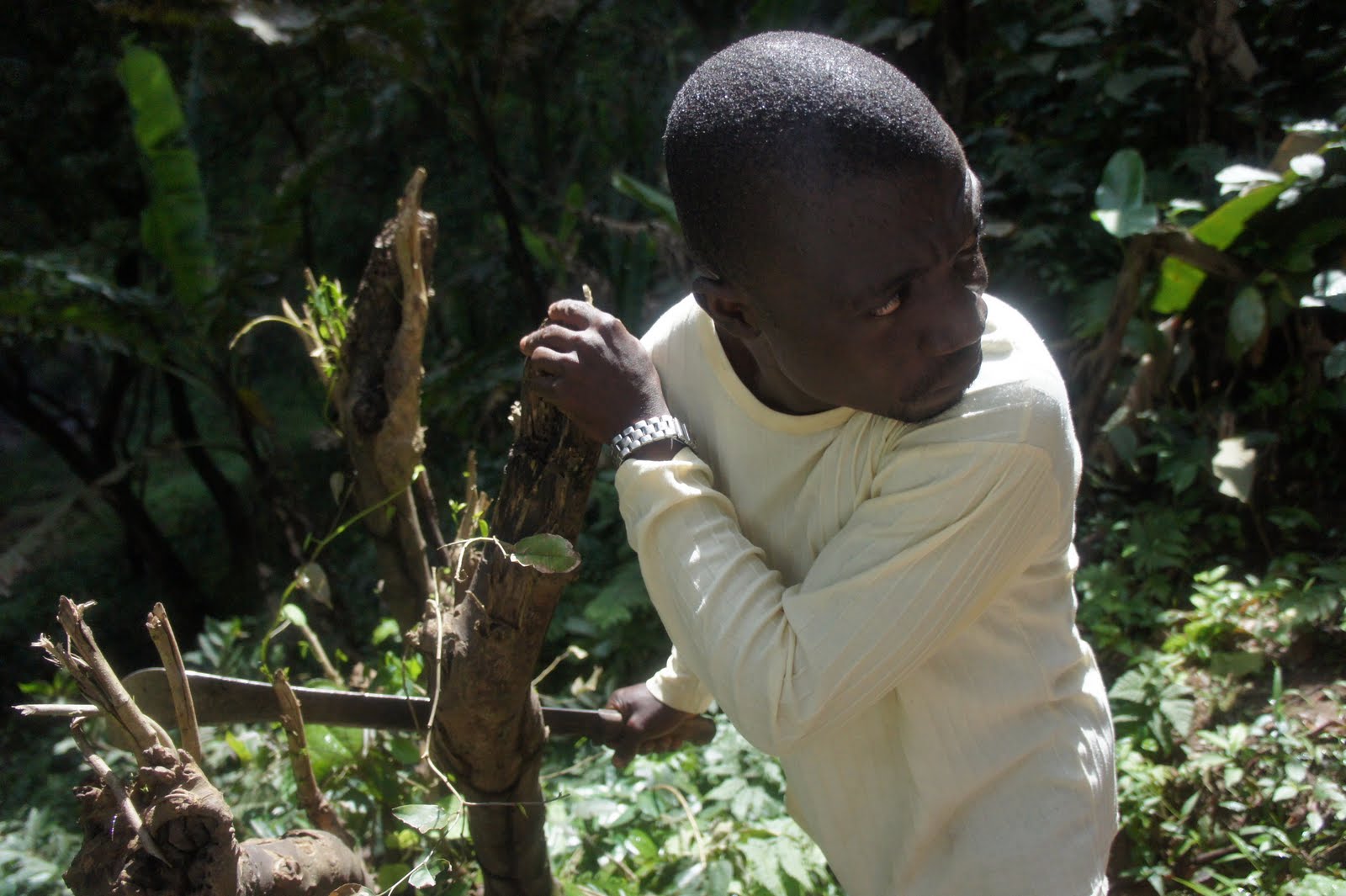
We set off at around 7.30am, taking with us a backpack each, swimming gear (we'd heard you could swim in the waterfall) and bottles of water. The first hour or two was the same trek as the day before: wide, flat and easy. After that, however, the path became very, very steep. Very quickly, it grew tiring. We climbed the mountain single file, with Anthony leading the way. Every now and then, he used his machete to cut away areas of the path that were overgrown. After close to two hours of the exhausting ascent, we reached the upper area of the Waterfall.

It was okay. Waterfalls don’t differ a whole lot in appearance and we didn’t swim in it (it was too powerful and not deep enough to be enjoyable), so it didn’t feel that much different to the one the day before. We rested there for a while, cooling down under the powerful winds created by the water's force, before setting off again, back up the mountain to follow the trek to Togo.
The mountain continued in its steepness and intensity. We continued climbing as before, in single fire and following Anthony’s lead and it took a lot longer than any of us expected. We had many pauses, as Anthony wanted to always ensure that we were all still there but this caused a fair bit of frustration among the group, as it took energy to stand still against the steepness.
A couple of hours later, the ground began to flatten. Around half of the group were Football volunteers with Projects-Abroad, but otherwise we were all fit enough that we coped with the climb. Anthony told us that it would be another 25 minutes to Togo, making lunch feel very close.
The border was a small river with two wooden planks laid out across it. The crossing wasn’t an official one, so there was no need for passports or visas. We crossed, one by one, and kept on walking.
Anthony, at this stage, made a habit of telling us that we were closer than we really were. His brief way of communicating with us meant that he would just answer that it wasn’t far, or say something like “20 minutes”. From the border to the village itself, we walked for what felt like ages, along a few different roads and around 2 o clock, we reached Tsadome.

Tsadome is a village of several hundred Togolese, all of whom come from only four families. In the town, there is a school of six classrooms that teaches around two hundred students, including many from surrounding villages.
As it was a Saturday, none of the children were in school and so they swarmed us on our arrival. They found us really fascinating and took a lot of joy in simply watching us, and especially playing with our cameras. A few were shy and watched us from around corners or from behind others. It felt as though we could’ve been the first foreigners to visit the town in a very long time, but Anthony said that the most recent trip had been around two months ago.
A few of the townspeople started cooking lunch for us when we arrived. We were insistent that it had to be fast as we had to get back down the mountain before nightfall, and despite their offer, it wasn’t practical for us to stay the night.
Very suddenly, as we sat on the porch of a small shop with the children, it started raining. Like the few times it's rained in Africa while I've been here, the downpour was very intense. It started to get very wet and we all went for cover inside the tiny shop. The rain was on and off again and it became very cold, and so there was uncertainty in the group about what we were doing.
While lunch was being prepared and in between the rain, we were given a brief tour of the town. The centre of Tsadome is mostly housing built from clay and dutch roofing and the outskirts is farmland. It is about 10km away from a larger city, which is where a lot of the townspeople travel to sell their produce.
Lunch took a long time to make and we all grew more impatient, as we had worked out already that we couldn’t stay the night and Anthony was continually elusive, so it was difficult to hurry things up. Eventually, at around 3 o clock, they served us lunch. It was one the nicest meals I've had in Africa and the one with the most vegetables.
We ate very fast, paid and found Anthony, insisting that we had to leave right away. He got the drift, but it still took him a while to organise himself. At around 3.30pm, we paid for our lunch and some drinks and left very promptly. We had a couple of hours to make it back down, or we risked facing the mountain in the dark.
Energized by the food and the threat of darkness, we walked very quickly, not stopping once. The mountain was wet in parts and so there was plenty of slipping on the way down. Anthony cut us all long sticks with his machete and insisted we all use them to help with the descent. They helped a lot.
The return trip was much faster than the journey up and we hit the flat trail again by around 6pm, as it got dark. We made it back by around 6.30pm, ending a long, exhausting but rewarding day.
On Sunday, we left Wli and on the way back to Accra stopped by a seaside village to go sailing in the Lake Volta. At first, they couldn't accommodate all nine of us on one boat but after a while of officials running around and negotiation on our part, they found a large boat and took us for a 45 minute ride. For some reason, two navy guys were on board, both armed and it wasn't the most captivating ride.

We returned to shore, had a quick look around the coastal township, the highlight of which was the sight of three men loading a large cow into the back of a taxi. Granted, the car was a station wagon but then, the cow was alive. Tired, we caught a tro-tro back to Accra for the bumpy ride home.
Subscribe to:
Posts (Atom)